


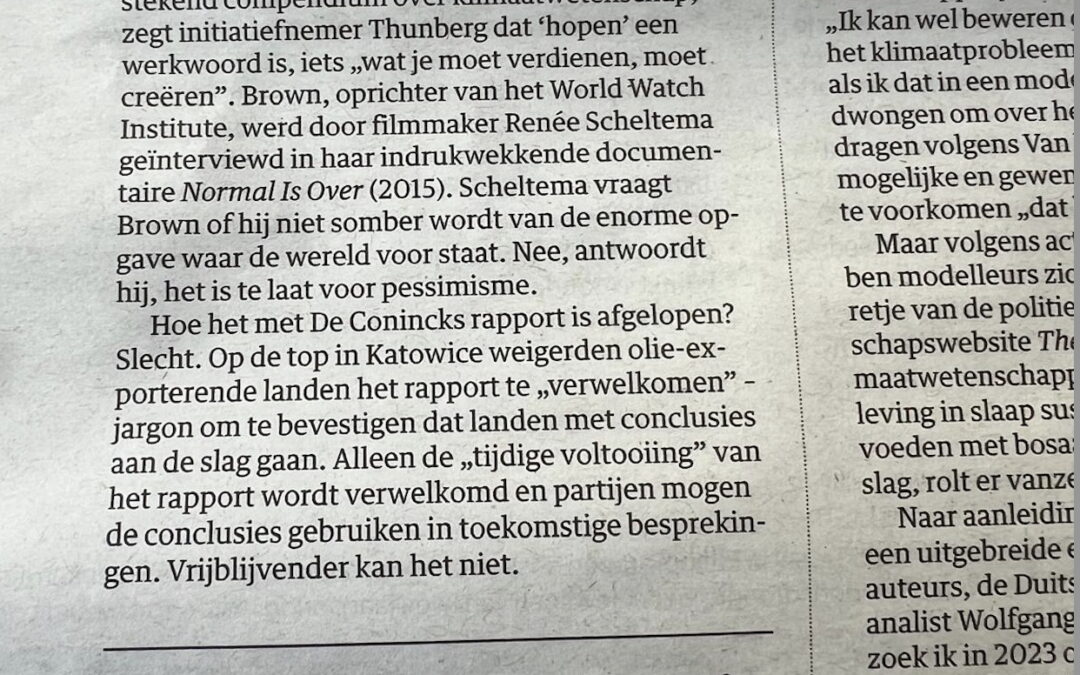
I am honored that Normal is Over is being featured in the Dutch quality newspaper NRC this weekend.
Eleven years after the film first screened at festivals, Normal is sadly more Over.
I spent five years working on this documentary as an independent filmmaker: filming, researching, producing, finding funding and editing. Together with my youngest daughter, Lisa, who was unfortunately unable to experience these festival screenings because she died in a senseless road accident just one day before the film was completed.
Elisa Emely was 25 years old.
I was heartbroken, for a period of at least seven years, but I still accepted those festival invitations. It was a distraction from the grief, and the message – that dreadful message that we are destroying the Earth, combined with the solutions I had found at the time – was the message I had to pass on. That is what Lisa would have wanted me to do too.
I opened up the film to dedicate Normal is Over to her as well. Lisa was already featuring at the start of the film, gazing out over the burnt mountains in Cape Town during an extreme drought.
I also wrote a short list of green solutions for the end of the film, like the circular economy, the zero-growth economy, the ‘stop shopping’ movement, regeneration, vegetarianism, etc.
Almost all crises today– more raw materials (war); ocean pollution, more drilling, more fishing; climate change due to an ever increasing use of dirty energy sources; the extinction of plant and animal species for more meat and more dairy products; air pollution caused by more CO₂, the desire for more clothing, more air travel, etc – can all be traced back to a single greedy, 300-year-old idea that you can achieve endless economic growth on a finite planet.
The idea that your life and that of future generations will always keep getting better and better is just absurd. From a philosophical and moral point of view alone, I think it is a ridiculous idea.
The forever-growth idea originated in colonial Western Europe, which was busy conquering the Third World, and thinking there would be forever ‘more’, stuff. The world seemed large back then, but after the first moon landing, the planet turns out to be just a small, fragile little sphere.
Today, three hundred years later, economic growth is still taught at universities as if it were a ‘law of nature’.. There is even a Nobel Prize in Economics, which is merely a behavioral science. After all, there isn’t a Nobel Prize for Sociology or Psychology.
It’s strange to think that just a tiny, elitist group of 10 people could solve this problem financially without becoming ‘poorer’ as a result.
Screenings of the film are still being held. There was one last week in Amsterdam and soon in Portugal:)
Recent Comments